Vendor Access in Manufacturing OT: Why Friction Is the Real Security Risk
Ben Burke, COO, Dispel
Ben Burke, COO, Dispel
Feb 4, 2026
Feb 4, 2026
min read
min read
min read
Article
Article
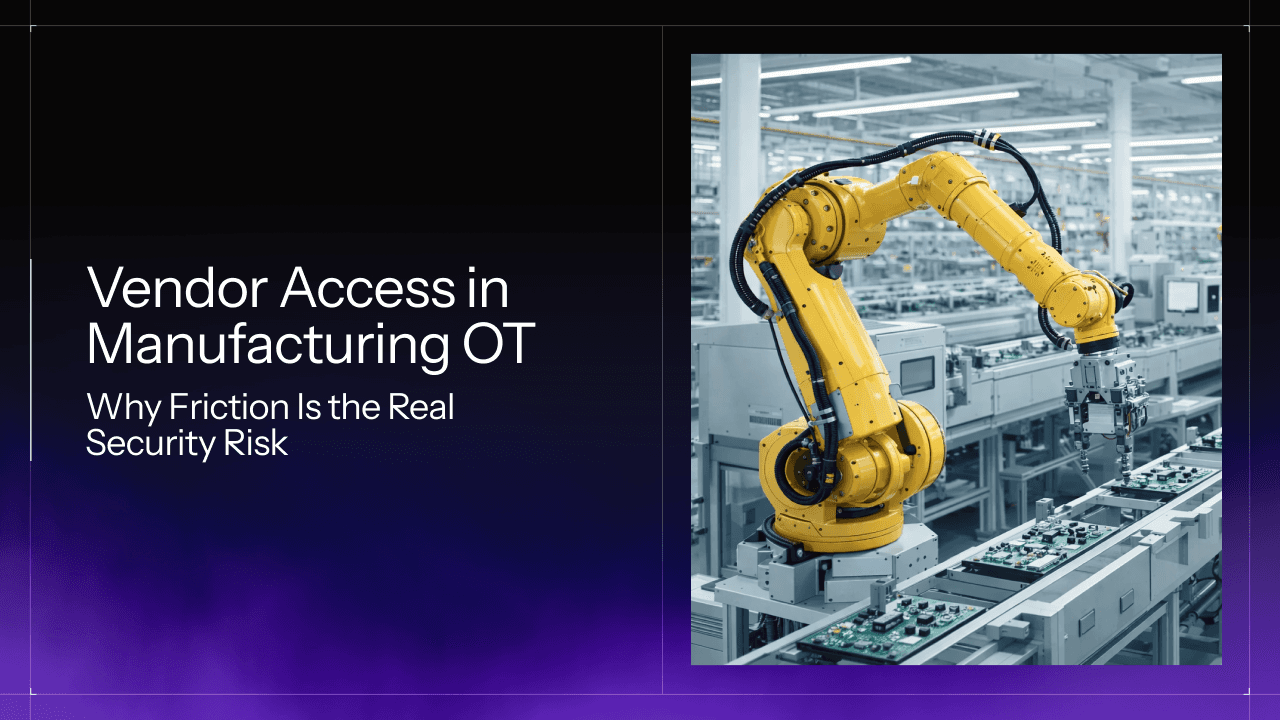
If you want to understand where secure remote access becomes challenging in manufacturing, don’t start with firewalls or compliance frameworks.
Start with how vendors actually support production.
Modern manufacturing depends on OEMs, system integrators, automation specialists, and contractors to keep lines running, assets tuned, and downtime short. Vendor access is not an exception in OT. It is foundational to how operations scale.
And it’s often where control becomes hardest to maintain. Not because anyone ignores security, but because traditional remote access workflows weren’t designed for the pace, urgency, and reality of manufacturing operations.
In practice, this friction shows up as slow onboarding, manual approvals, inconsistent access methods by site, and access tools that fail when uptime is on the line. When access introduces delay or uncertainty, it stops working in practice.
When Vendor Access Slows Down, Plants Route Around It
I worked with a global manufacturer that depended on OEM support to keep critical production lines running. On paper, their vendor onboarding process was sound. IT approvals were required, accounts were created manually, and workflows were documented.
In reality, onboarding a vendor engineer often took days.
That may be acceptable for corporate IT. It is not acceptable when a production line is down or a batch is at risk. Under pressure, the plant did what it needed to keep operations moving.
These were not security decisions. They were responses to operational friction.
Old credentials were reused.
Legacy VPN access remained in place.
Access details were shared informally.
None of this was malicious. It was operational necessity.
The longer onboarding took, the more often it was bypassed. Each workaround reduced visibility into who was actually accessing OT systems.
The bottleneck was not security capability.
It was time.
Vendor Turnover Turns Static Access Into Growing Risk
Vendor relationships in manufacturing are never static. Support teams rotate. Integrators change employers. Contractors move between projects.
Yet many OT environments still treat vendor access as something provisioned once and rarely revisited.
Over time, this creates a familiar pattern. Vendor accounts linger. Permissions expand beyond their original purpose. Ownership becomes unclear. When incidents occur, teams struggle to answer basic questions:
Who still has access?
What systems can they reach?
Which connections are tied to active service contracts?
This lack of clarity increases risk, slows incident response, and weakens accountability. More importantly, it puts uptime at risk. When access is uncontrolled, organizations face a choice between reacting slowly to protect systems or moving quickly without full confidence in who is connected. Neither is acceptable in a production environment.
Each of these failures traces back to operational friction: access that is hard to grant correctly, harder to revoke cleanly, and almost impossible to audit under pressure.
When Vendor Access Is Hard, Trust Breaks Down
Poor vendor access does more than increase cyber risk. It undermines trust across operations, security, and third parties.
Vendors lose confidence when sessions drop or diagnostic tools fail. Operators lose patience with approval delays and inconsistent processes. Security teams respond by tightening controls, which creates more exceptions and more workarounds.
This is the friction loop in OT: controls increase, usability drops, workarounds multiply, and real visibility disappears.
Over time, productivity is restored through unofficial paths. Those paths become the real access model, operating outside governance and visibility.
In OT environments, trust is not rebuilt through policy or mandates.
It is rebuilt through access that works every time it is needed.
See how teams are reducing remote access risk [Read SANS A Critical Control for Modern Risk Whitepaper]
Fast, Predictable Vendor Onboarding Changes Behavior
I’ve also seen what happens when vendor access is redesigned around operational reality.
At another manufacturer, vendor remote access followed one principle:
The approved path must be the fastest path.
Speed did not reduce control. It removed friction that had been driving risk underground.
Vendors onboarded themselves through a controlled process. Access was scoped by facility and asset, time-bound by default, and consistent across sites.
The results were immediate.
Vendors used the approved system because it helped them work faster.
Operators stopped calling for exceptions.
Security gained full session visibility without increasing administrative load.
Nothing about production pressure changed.
The process did.
Speed removed the incentive to bypass controls.
Why IT-Style Vendor Models Fail in OT
Many organizations try to force OT vendor access into traditional IT identity models. That usually backfires.
Vendors don’t behave like employees. Over years, you may see hundreds of sessions—but rarely the same individual twice. Forcing every vendor into corporate IAM creates high costs, slow onboarding, and pressure to revert to shared accounts.
OT needs a different model:
Vendor self-onboarding without bureaucratic delay
Flexible identity options (customer SSO, vendor SSO, or strong local auth)
Time-bound access that expires automatically
Full session attribution without forcing vendors into corporate IAM
When onboarding takes minutes instead of days, vendor resistance disappears.
Vendor Access Is Where Efficiency and Security Converge
Vendor access sits at the intersection of uptime, safety, and cyber risk.
When access is slow, teams work around it.
When access is unreliable, trust erodes.
When workflows vary by site, shadow processes emerge.
When vendor access is fast, predictable, and aligned with plant operations, security improves as a byproduct of efficiency.
Access expires when work is complete.
Sessions are logged and reviewed without friction.
Vendors reach only the assets they are authorized to support.
This shift does not happen because teams care more about compliance.
It happens because the access model respects operational reality.
Where This Leaves Manufacturing
Vendor access is no longer a secondary concern in OT.
It is one of the most active control points in modern manufacturing.
Manufacturers do not lose control because they ignore security. They lose control when secure access slows response, disrupts production, or forces workarounds just to keep lines running.
The organizations making real progress are not adding friction. They are redesigning access so the approved path is the fastest path, scoped, time-bound, and reliable when uptime is on the line.
When vendor onboarding takes minutes instead of days, behavior changes.
Vendors stay inside the system.
Operators trust the process.
Security regains visibility without becoming the bottleneck.
That is not a tradeoff between efficiency and security.
It is how manufacturing builds operational control that actually scales.
This is the approach modern manufacturers are taking with platforms like Dispel, where vendor access is designed for how plants actually operate, not IT convenience.
Ready to Simplify OT Secure Remote Access?
See how Dispel helps industrial teams standardize connectivity and protect critical environments—without added complexity.
If you want to understand where secure remote access becomes challenging in manufacturing, don’t start with firewalls or compliance frameworks.
Start with how vendors actually support production.
Modern manufacturing depends on OEMs, system integrators, automation specialists, and contractors to keep lines running, assets tuned, and downtime short. Vendor access is not an exception in OT. It is foundational to how operations scale.
And it’s often where control becomes hardest to maintain. Not because anyone ignores security, but because traditional remote access workflows weren’t designed for the pace, urgency, and reality of manufacturing operations.
In practice, this friction shows up as slow onboarding, manual approvals, inconsistent access methods by site, and access tools that fail when uptime is on the line. When access introduces delay or uncertainty, it stops working in practice.
When Vendor Access Slows Down, Plants Route Around It
I worked with a global manufacturer that depended on OEM support to keep critical production lines running. On paper, their vendor onboarding process was sound. IT approvals were required, accounts were created manually, and workflows were documented.
In reality, onboarding a vendor engineer often took days.
That may be acceptable for corporate IT. It is not acceptable when a production line is down or a batch is at risk. Under pressure, the plant did what it needed to keep operations moving.
These were not security decisions. They were responses to operational friction.
Old credentials were reused.
Legacy VPN access remained in place.
Access details were shared informally.
None of this was malicious. It was operational necessity.
The longer onboarding took, the more often it was bypassed. Each workaround reduced visibility into who was actually accessing OT systems.
The bottleneck was not security capability.
It was time.
Vendor Turnover Turns Static Access Into Growing Risk
Vendor relationships in manufacturing are never static. Support teams rotate. Integrators change employers. Contractors move between projects.
Yet many OT environments still treat vendor access as something provisioned once and rarely revisited.
Over time, this creates a familiar pattern. Vendor accounts linger. Permissions expand beyond their original purpose. Ownership becomes unclear. When incidents occur, teams struggle to answer basic questions:
Who still has access?
What systems can they reach?
Which connections are tied to active service contracts?
This lack of clarity increases risk, slows incident response, and weakens accountability. More importantly, it puts uptime at risk. When access is uncontrolled, organizations face a choice between reacting slowly to protect systems or moving quickly without full confidence in who is connected. Neither is acceptable in a production environment.
Each of these failures traces back to operational friction: access that is hard to grant correctly, harder to revoke cleanly, and almost impossible to audit under pressure.
When Vendor Access Is Hard, Trust Breaks Down
Poor vendor access does more than increase cyber risk. It undermines trust across operations, security, and third parties.
Vendors lose confidence when sessions drop or diagnostic tools fail. Operators lose patience with approval delays and inconsistent processes. Security teams respond by tightening controls, which creates more exceptions and more workarounds.
This is the friction loop in OT: controls increase, usability drops, workarounds multiply, and real visibility disappears.
Over time, productivity is restored through unofficial paths. Those paths become the real access model, operating outside governance and visibility.
In OT environments, trust is not rebuilt through policy or mandates.
It is rebuilt through access that works every time it is needed.
See how teams are reducing remote access risk [Read SANS A Critical Control for Modern Risk Whitepaper]
Fast, Predictable Vendor Onboarding Changes Behavior
I’ve also seen what happens when vendor access is redesigned around operational reality.
At another manufacturer, vendor remote access followed one principle:
The approved path must be the fastest path.
Speed did not reduce control. It removed friction that had been driving risk underground.
Vendors onboarded themselves through a controlled process. Access was scoped by facility and asset, time-bound by default, and consistent across sites.
The results were immediate.
Vendors used the approved system because it helped them work faster.
Operators stopped calling for exceptions.
Security gained full session visibility without increasing administrative load.
Nothing about production pressure changed.
The process did.
Speed removed the incentive to bypass controls.
Why IT-Style Vendor Models Fail in OT
Many organizations try to force OT vendor access into traditional IT identity models. That usually backfires.
Vendors don’t behave like employees. Over years, you may see hundreds of sessions—but rarely the same individual twice. Forcing every vendor into corporate IAM creates high costs, slow onboarding, and pressure to revert to shared accounts.
OT needs a different model:
Vendor self-onboarding without bureaucratic delay
Flexible identity options (customer SSO, vendor SSO, or strong local auth)
Time-bound access that expires automatically
Full session attribution without forcing vendors into corporate IAM
When onboarding takes minutes instead of days, vendor resistance disappears.
Vendor Access Is Where Efficiency and Security Converge
Vendor access sits at the intersection of uptime, safety, and cyber risk.
When access is slow, teams work around it.
When access is unreliable, trust erodes.
When workflows vary by site, shadow processes emerge.
When vendor access is fast, predictable, and aligned with plant operations, security improves as a byproduct of efficiency.
Access expires when work is complete.
Sessions are logged and reviewed without friction.
Vendors reach only the assets they are authorized to support.
This shift does not happen because teams care more about compliance.
It happens because the access model respects operational reality.
Where This Leaves Manufacturing
Vendor access is no longer a secondary concern in OT.
It is one of the most active control points in modern manufacturing.
Manufacturers do not lose control because they ignore security. They lose control when secure access slows response, disrupts production, or forces workarounds just to keep lines running.
The organizations making real progress are not adding friction. They are redesigning access so the approved path is the fastest path, scoped, time-bound, and reliable when uptime is on the line.
When vendor onboarding takes minutes instead of days, behavior changes.
Vendors stay inside the system.
Operators trust the process.
Security regains visibility without becoming the bottleneck.
That is not a tradeoff between efficiency and security.
It is how manufacturing builds operational control that actually scales.
This is the approach modern manufacturers are taking with platforms like Dispel, where vendor access is designed for how plants actually operate, not IT convenience.
Ready to Simplify OT Secure Remote Access?
See how Dispel helps industrial teams standardize connectivity and protect critical environments—without added complexity.



Products
Industries
New
Resources
Products
Industries
New
Resources
Products
Industries
New
Resources